Population Density on the Westside

The Westside generally lives up to its reputation for lower-densities and decentralization compared to Downtown and Hollywood, though it sustains respectable density levels for an American city. There are 424,233 people living within the 39 square miles east of Santa Monica Bay, south of San Vicente and Sunset, west of Doheny/Robertson, and north of Jefferson, creating a residential density of 10,857 people per square mile. These densities are pretty evenly spread out across the district. Office space is fragmented throughout the district, with clusters in Westwood, Century City, Beverly Hills, West LA, Santa Monica, and Marina Del Rey. It would be interesting to find out the square footage and the distribution of office space in this sub-region. The Westside system would direct future office development toward the land around Santa Monica Boulevard and Westwood, forming two axes that would eventually connect Century City to Westwood/Wilshire, Santa Monica/Sepulveda, and the Veteran's Administration.
High-density commercial and residential development would cluster around radial lines like Sepulveda and Venice that feed into this new commercial core. Currently, land around Venice Boulevard is underutilized because massive amounts of valuable commercial land is consumed by automotive uses. Planning for the Expo in general and the Venice-Sepulveda alignment specifically should take into account the development potential of the Venice corridor as well as its gradual conversion to a less automobile and more pedestrian and transit orientation. Meanwhile, the Sepulveda corridor north of the Santa Monica freeway is presently devoted to low-intensity industrial, wholesale, and warehousing uses. These are inappropriate uses for such valuable centrally located land and could be converted to either office or high-density residential use. Both Venice and Sepulveda corridors are appropriate for higher intensity office, residential, and commercial land uses that would feed directly into Westwood/UCLA core and tie into the larger transit network. They also could act as development magnets, attracting development towards transit nodes while also drawing development away from adjacent low-density neighborhoods.
Station Density of the Westside System
In Cities in Full, Steve Belmont explains the concept of station density within transit systems.
The most basic measure of a rail system’s quality of service to the central neighborhoods in its metropolis is the number of stations it devotes to those neighborhoods; the larger the number of strategically sited stations, the larger the number of existing and future households within walking distance of rail. If a rail system serves its central area well, that central area will have high station density... A transit system’s quality of service to the central neighborhoods in its metropolis can be most accurately assessed by counting the number of stations inside the central area but outside the downtown nucleus, which is composed largely of non-residential land uses.

Belmont refers to the residential area surrounding (but not including) the downtown nucleus as the metropolitan area’s central residential ring (CRR). These residential rings should ideally be high-density with a high number of stations within walking distance. Belmont provides the following examples of transit systems with both high and low station densities:
Paris has the highest station density of any other city in the western world with a CRR station density of 3.20 stations per square mile.

Manhattan has a CRR station density of 3.57 stations per square mile. San Francisco has a CRR station density of 1.14 stations per sq. mile.
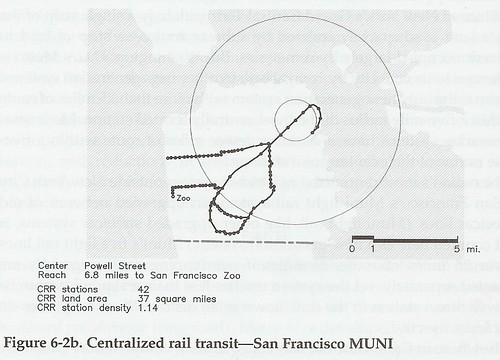
Washington, DC, has a low CRR density of .54 stations per square mile.

The full build-out of the Westside system would have a station density of .84 stations per square mile. As population density increases as a result of recentralization, infill stations and new lines could be added as needed to further boost station density.


3 comments:
Great stuff!
John,
Where does West Hollywood fit into this picture?
West Hollywood falls into the Central Transit District. It was a tough call as to where the Central District ends and the Westside begins, but Doheny and Robertson roughly constitute the boundary between the two. But aside from its western border with Beverly Hill, West Hollywood is must more strongly oriented towards Hollywood overall.
Post a Comment