
Monday, December 31, 2007

Wednesday, December 26, 2007
Orange Line (Revised)

I had intended for the Orange Line to be a heavy rail subway and not a mixed grade light rail as I detailed in my previous post, but I was concerned about the feasibility of a subway from Glendale to Pasadena. Unfortunately light-rail would not be able to be linked up to the Red Line or utilize the existing tunnel under Hollywood Boulevard and Runyon Canyon. Therefore, I decided to rework the Orange line.
The connection between Glendale and Pasadena will be a separate light-rail line since light-rail works so well through that corridor and such a line could easily connect with the Gold Line at the Lake Avenue station. This would free up the Orange Line to serve Burbank via Glendale, utilizing the surface rail right-of-way along the San Fernando roughly between Broadway and Western.
Because the Orange Line would serve Burbank through Glendale rather than North Hollywood, the existing Orange BRT line could be extended (after being rechristened to avoid confusion, of course) to connect Burbank from the west. (Not shown on diagram)
Sunday, December 16, 2007
Proposed eastern branch of future Orange Line
View Larger Map
Mode: Light Rail
Grade: Combined At-grade and Below-grade (tunnel)
Distance (approx): 11 miles
Description: The eastern branch of the future Orange line will largely follow the current path of the 780 Express bus. The light rail will begin at a tunnel connecting to the Red Line at the Vermont and Sunset subterranean station. It will go north underground under the Los Feliz district and come to the surface at Los Feliz Boulevard and Hillhurst Avenue. From there, it will travel eastward above ground along Los Feliz Blvd across the 5 and the Los Angeles river to San Fernando Road, where it will go undeground again. The line will go north under either Central Avenue or Brand Blvd to Broadway in Glendale. The line will continue eastward underneath Broadway to Verdugo Rd, where it will return to the surface to Colorado Blvd. The remainder of the line will be a surface route, following Colorado Blvd through Eagle Rock before turning onto the entrance ramp for the Ventura Freeway. The final leg of the route will run along the Ventura and Foothill freeways and connect with the Lake Avenue Station on the Gold Line.
Tuesday, December 11, 2007
Why the Red Line should be double tracked

A. Allow for local and express trains
(See NYC Subway)
- because it's the only line that serves all 3 CBDs and LAX
- because of its length and role as backbone of the system and each individual CBD
- to quicken direct access and reduce travel time between the three CBDs and LAX
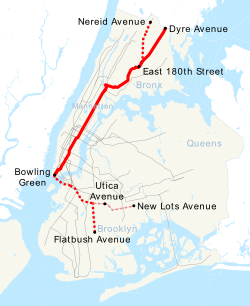
B. Increase capacity and reduce congestion
(see WDC's Orange/Blue and Yellow/Green lines, )
C. Create "passing lane"/pull off tracks in the case of disabled train or other track blockage
(see SF Muni, DC Metro - negative examples)
D. Allow for use of tunnels by multiple lines/branches
(see SF Muni)
Wednesday, December 5, 2007

Tuesday, December 4, 2007

Sunday, December 2, 2007

Saturday, December 1, 2007

Monday, November 26, 2007

Saturday, November 24, 2007

Friday, November 23, 2007

Tuesday, November 20, 2007
Transit Network Orientation and Organization
East-West lines (Shore, Valley, Wilshire, Expo, and Gateway):
LA’s rail transit network has an east-west orientation, with the Shore line as the system’s axis. In addition to connecting the three primary central business districts (Downtown, Hollywood, and Westwood), the Shore line links most of the major destinations within central LA and the Westside.
North of Hollywood, the Valley line mirrors the Shore line as the primary axis for the Valley, connecting its major cities and districts and feeding directly into the system core at Hollywood.
South of Hollywood, the Wilshire and the Expo lines both run parallel to the Shore line and directly connect Westwood and Downtown, with the perpendicular Central line providing connections to Hollywood. The Gateway line serves primarily as a feeder line for the Gateway region, connecting the Long Beach line, the ends of the Central and the Shore lines, and LAX.
North-South lines (Central, Sepulveda, Gold, and Long Beach):
North-south lines run perpendicular to the network’s dominant east-west orientation and function primarily as feeder routes from the periphery (South Los Angeles, the Gateway region, the Valley, and the Eastside) to the core. The Central line serves an additional role connecting the Expo, Wilshire, and Shore lines to create a pair of cross-town routes into Hollywood.
Monday, November 19, 2007
Route Descriptions

The Shore Line – links the three primary CBDs (Downtown, Hollywood, & Westwood) as well as the foothill and beach cities before ending at LAX.
The Wilshire Line – runs parallel to Hollywood along Wilshire Boulevard and directly connects Miracle Mile, Hancock Park, and Koreatown with Downtown and Westwood. (direct access to Hollywood provided by the Central Line)
The Valley Line – links the chain of inner valley cities and directly connects them with Hollywood, with single transfer connections to Downtown and Westwood.
The Expo Line – directly connects University Park, Baldwin Hills, and Culver City with Downtown and Westwood, with single transfer connections to Hollywood.
The Central Line – directly connects South Los Angeles and the Wilshire district with Hollywood, with single transfer connections from South Los Angeles to Downtown and Westwood; western branch also directly connects Hollywood and LAX.
The Sepulveda Line – directly connects the San Fernando Valley with Westwood, with single transfer connections to Hollywood and Downtown.
The Gold Line – directly connects Pasadena, Boyle Heights, and East LA with Downtown, with single transfer connections to Hollywood and Westwood.
The Long Beach Line - runs north from Long Beach through the Gateway region, with direct connections to Downtown and single transfer connections to Hollywood and Westwood.
The Gateway Line – runs east from LAX through the Gateway region, with single transfer connections to Downtown, Hollywood, and Westwood.
My proposal for the Los Angeles subway (Revised 11/19/07)
Primary Central Business Districts (CBDs)
a. Downtown
b. Hollywood
c. Westwood
Directly connected to all 3 CBDs
a. Santa Monica/Venice/West L.A.
b. Beverly Hills/West Hollywood
c. Los Feliz/Silverlake/Echo Park
d. Miracle Mile/Hancock Park/Koreatown
e. Baldwin Hills
f. USC/University Park
g. Westchester/LAX
Directly connected to 2 CBDs
a. Pasadena
b. Culver City
c. Sherman Oaks
Directly connected to 1 CBD
a. Encino
b. Studio City
c. Universal City
d. North Hollywood
e. Burbank
f. Glendale
g. Eagle Rock
h. Boyle Heights/East L.A.
i. Southgate/Lynwood
j. Morningside Park
k. Inglewood
My LA subway plan is based upon latent but unrealized relationships that organize Los Angeles. The core of the system is built upon two parallel corridors (the Red and the Purple Lines) connecting three central business districts (Downtown, Hollywood, and Westwood/Century City). As the only line connecting all three CBDs, the Red line serves as the backbone of the system. The Purple line acts as a secondary parallel corridor and the backbone of the Wilshire District as it radiates outward from downtown towards the “new downtown” of Century City.
The area served by these two lines is Los Angeles’ equivalent of Manhattan. This is the heart of the metropolis, where the region’s cultural and commercial energy is primarily concentrated. The spacial relationships between the three CBDs similarly mirror those of Manhattan: the original downtown office district (Downtown LA/Lower Manhattan) followed by a second central business district (Hollywood & Mid-Wilshire/Mid-town Manhattan). Los Angeles adds a third emerging CBD with Century City and Westwood.
If the central corridor represents LA’s equivalent of Manhattan, the San Fernando Valley, The San Bernadino Valley, and South Los Angeles all represent LA’s equivalent of the outer boroughs. As such the Orange, Gold, Blue, Yellow, and Pink lines act as feeder routes providing service from the progressively less dense residential regions into the center city. The Yellow line also serves as a cross-town route connecting Hollywood and Wilshire, while the Orange and the Expo lines serves as “side corridors” linking the closer in centers (Orange: Pasadena, Glendale, Universal City, Studio City, Sherman Oaks, & Encino; Expo: Culver City, Baldwin Hills, & USC/University Park).
This subway system will serve two roles. Most immediately, it will relieve the congestion that is choking our metropolitan area and draining it of its resources (time, money, fuel, environment). But perhaps more importantly, it creates a framework upon which we can most effectively and sustainably direct further growth and development. The space in all three CBDs currently remains ineffectively and under-utilized. At the same time, new development continues to expand the edges of our metropolis further outward. Our first priority should be directing new commercial, business, and residential development away from the peripheral areas and back towards the cores, where infrastructure is most concentrated and of greatest practical use. Neither the region nor the world can afford to continue squandering our resources on increasing sprawl. It's time to invest in what we have.
My proposal for the Los Angeles subway

Primary Central Business Districts (CBDs)
a. Downtown
b. Hollywood
c. Westwood
Directly connected to all 3 CBDs
a. Santa Monica/West L.A.
b. Beverly Hills/West Hollywood
c. Los Feliz/Silverlake/Echo Park
d. Miracle Mile/Hancock Park/Koreatown
Directly connected to 2 CBDs (all others require 1 transfer)
a. Pasadena
b. USC/University Park
c. Baldwin Hills
d. Culver City
e. Westchester/LAX
f. Sherman Oaks
Directly connected to 1 CBD (all others require 1 transfer)
a. Encino
b. Studio City
c. Universal City
d. North Hollywood
e. Burbank
f. Glendale
g. Eagle Rock
h. Boyle Heights/East L.A.
i. Southgate/Lynwood
j. Morningside Park
k. Inglewood
l. Venice/Mar Vista
Transfers required to LAX from:
a. Westwood: 0
b. Hollywood: 0
c. Downtown: 1
My LA subway plan is based upon latent but unrealized relationships that organize Los Angeles. The core of the system is built upon two parallel corridors (the Red and the Purple Lines) connecting three central business districts (Downtown, Hollywood, and Westwood/Century City). As the only line connecting all three CBDs, the Red line serves as the backbone of the system. The Purple line acts as a secondary parallel corridor and the backbone of the Wilshire District as it radiates outward from downtown towards the “new downtown” of Century City.
The area served by these two lines is Los Angeles’ equivalent of Manhattan. This is the heart of the metropolis, where the region’s cultural and commercial energy is primarily concentrated. The spacial relationships between the three CBDs similarly mirror those of Manhattan: the original downtown office district (Downtown LA/Lower Manhattan) followed by a second central business district (Hollywood & Mid-Wilshire/Mid-town Manhattan). Los Angeles adds a third emerging CBD with Century City and Westwood.
If the central corridor represents LA’s equivalent of Manhattan, the San Fernando Valley, The San Bernadino Valley, and South Los Angeles all represent LA’s equivalent of the outer boroughs. As such the Orange, Gold, Blue, Yellow, and Pink lines act as feeder routes providing service from the progressively less dense residential regions into the center city. Both the Yellow and the Pink lines each serve the additional role of cross-town route running perpendicular to the central corridor, while the Orange line serves as a “side corridor” linking the two Valleys’ most appealing downtowns (Pasadena, Glendale, Universal City, Studio City, Sherman Oaks, & Encino).
The Expo line serves two roles: a radial route connecting downtown to Culver City and Venice, and a link providing direct connections to Hollywood and Westwood. The Pink and the Green lines work together to form an “outer” circumferential route largely bypassing the central corridor and directly connecting the peripheral areas.
This subway system will serve two roles. Most immediately, it will relieve the congestion that is choking our metropolitan area and draining it of its resources (time, money, fuel, environment). But perhaps more importantly, it creates a framework upon which we can most effectively and sustainably direct further growth and development. The space in all three CBDs currently remains ineffectively and under-utilized. At the same time, new development continues to expand the edges of our metropolis further outward. Our first priority should be directing new commercial, business, and residential development away from the peripheral areas and back towards the cores, where infrastructure is most concentrated and of greatest practical use. Neither the region nor the world can afford to continue squandering our resources on increasing sprawl. It's time to invest in what we have.
Subscribe to:
Posts (Atom)

